OK – you've got time for one pun. John loves puns. The Greek verb in vs. 5b means either "comprehend" or "physically overcome," depending on the context. My favorite translation of this verse has "grasp," which means exactly the same thing, depending on the context. Most translations choose one or the other of the meanings.
John 1:6-8, 19-28
So many people were going out to hear John and to be baptized by him that the religious authorities decided they needed to know what was going on. They wanted to know if he claimed to be the Messiah or, as they no doubt had heard, a new version of either Elijah or Moses ("the Prophet"). He said no; Jesus later said yes.
One thing I like about the Gospel of John is the little, irrelevant details. John is giving us this beautiful, poetic message about the light of the world and the messenger sent from God, and then all of a sudden, "This happened in Bethany on the other side of the Jordan." It doesn't really matter to the story, which convinces me that it is the true memory of an eye witness.
John 1:29-42
The disciples of Jesus were a mixed group, called at various times from various walks of life. We also see in the gospels what seem to be conflicting accounts of when and where some of them were called. I have no problem with this. Were you called to your job when you heard about the opening, were invited to an interview, or were offered the position? Were you called to your marriage when you met your spouse, got engaged, or said, "I do"? Today we see that two of the earliest disciples, X and Andrew, were previously disciples of John the Baptist. Charles R. Erdman notes that the first four disciples named came to Jesus in four different ways: Andrew through the testimony of his teacher John the Baptist; Peter through the witness of his brother Andrew; Philip in response to a direct call from Jesus (1:43), and Nathaniel in a spirit of honest but skeptical inquiry (1:46). X is usually thought to be John the disciple, who never mentions his own name in this gospel, and whom we know to be an early follower. John typically provides a lot of minor eye-witness details, so his failure to give a name here is best explained by its being his own name.
John 2:13-22
When it comes right down to it, the world is a lot simpler than we want it to be. We want it to be complicated for one of two reasons:
- It's so complicated that only I, in my superiority to you, can understand it. Therefore you must do as I say.
- It's so complicated that nobody can understand it, therefore I can do whatever I want.
Jesus said, "OUT! This new system is unacceptable!" Paul said, "God's message is so wise that people who think they are smart can't understand it, but for anyone who truly wants to understand it, it's simple." God's new system is even simpler than his old system: if you sin, Jesus has already paid for it in blood. All you have to do is pick up the receipt. See also 1 Corinthians 1:18-25.
John 3:1-17
Our passage for today is so rich that no matter what I say, I'll leave out at least 16 important points. The Pharisees were the really well-educated, religious people in Judah. Nicodemus was a leader of the Pharisees. Jesus expected him to be able to understand what he was hearing. But as well-educated, religious people ourselves, we know that sometimes what we know gets in the way of learning something new. Nicodemus had the same problem. Another problem was that while he wanted to visit Jesus, he didn't want anyone to know about it – that's why he came at night. No matter how you get your news, you know you can probably believe it if it's "eye witness news." Jesus told Nicodemus, "I'm giving you eye-witness news about stuff you already know, and you don't understand it. How can I teach you anything new?"
And what's with the snake? Back in the desert, the Israelites were (as usual) complaining about God, and they got struck with a plague of poisonous snakes (Numbers 21:4-9). God told Moses to make a snake out of bronze and put it up on a pole for the people to look at so that they could be cured. This is almost universally taken in the Church to be a foreshadowing of our salvation from the plague of sin by the lifting up of Jesus on the cross.
Here's a special note on John 3:13-17. Do you have a red-letter edition of the Bible? These editions have the words of Jesus printed in red, but you need to exercise a little caution when you're reading one of them. The manuscripts of the Greek New Testament don't have quotation marks, verse numbers, or chapter breaks. There is a Greek word, hoti, that introduces a direct quotation. (It can also introduce an indirect quotation, but translators can almost always figure that out.) The tricky part is that Greek has no way of showing that direct quotation has stopped. It's clear when the subject changes - say, to "she" or "they" - that Jesus has stopped speaking. Many times in the book of John, however, it's difficult to tell where Jesus stops speaking and John starts explaining what he said. Scholars differ, but don't get excited about it: whether the words are from Jesus or from John speaking by the inspiration of the Holy Spirit, it is still the word of the Lord. Most modern scholars accept that the quotation from Jesus ends with vs. 13, and they attribute 14-17 to John's commentary on what Jesus was saying. A lot of people believe instead that Jesus personally said John 3:16-17. The Greek text of the Bible doesn't have ending quotation marks, so whatever anyone wants to think about that is okay with me.
John 3:8
Do you like puns? Do you know the story about the old cattle rancher who turned the operation over to his boys and renamed the spread "Focus"? When his friends asked why, he said, "Because this is where the sons raise meat."
The disciple John loved puns, and today's scripture records a great three-word pun from Jesus in vs. 8. In Greek, three words have more than one meaning. Pneuma means wind or spirit. Pnei means blows (for wind) or breathes out (for persons). Phonen means sound or voice. (Several other words mean either it or he.) So verse 8 can be translated with equal accuracy in two ways.
- The wind blows where it wishes, and you hear its sound, but you do not know where it comes from or where it goes.
- The Spirit breathes out where he wishes, and you hear his voice, but you do not know where he comes from or where he goes.
John 3:5-8 6/3/09)
Sometimes I wish I knew a lot more about Greek (without the necessity of taking more classes). The Greek word pneuma is used 350 times in the New Testament. It is translated "spirit" or "Ghost" (as in Holy Ghost) 349 times in the King James Version. Once, it is translated "wind" (John 3:8). What is up with that? Phonay is used 129 times; 119 times it is translated as "voice"; 8 times (once in John 3:8) as "sound"; and twice as "noise." I've said before that John seems to love puns and that 3:8 is a great multi-word pun. Is Jesus talking about the voice of the Spirit, or the sound of the wind? Yes. What you hear depends on whether your ears have been born of the Spirit.
- 3:5-7 Jesus answered, “Truly, truly, I say to you, unless one is born of water and the pneuma Spirit, he cannot enter the kingdom of God. That which is born of the flesh is flesh, and that which is born of the pneuma Spirit is pneuma spirit. Do not marvel that I said to you, ‘You must be born again.’
3:8 “The pneuma wind blows where it wishes, and you hear its phonay sound, but you do not know where it comes from or where it goes. So it is with everyone who is born of the pneuma Spirit.”
John 4:5-42
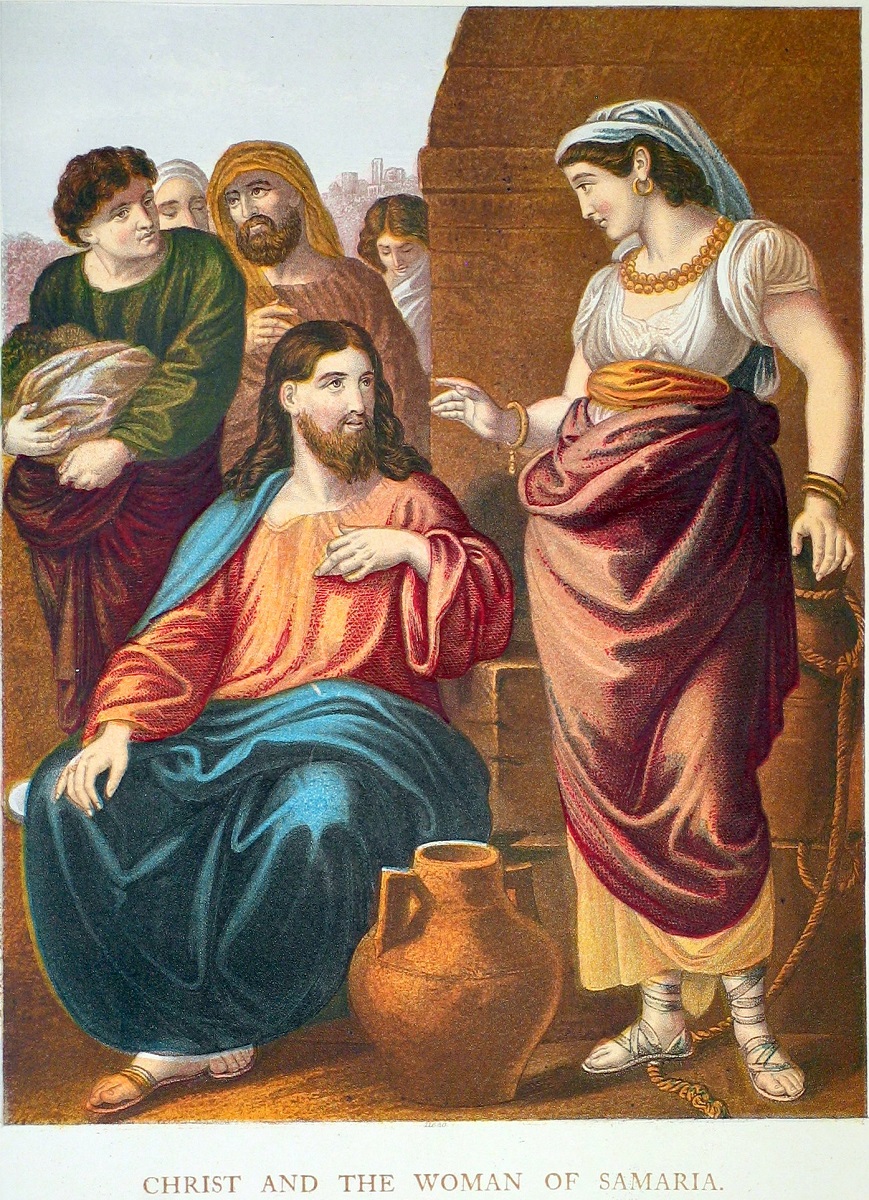
Both of the scripture passages for today contrast physical food and water with heavenly food and water. I like this Samaritan woman: she is a sharp cookie. The first thing she asks Jesus is, "You are a Jewish man. I'm a Samaritan woman. I know that Jews don't talk to Samaritans, and Jewish men don't talk even to Jewish women in public. What gives?" The second thing she says is, "Oh, right. You are going to give me water? You don't even have a bucket!" Satisfied with the answers, and impressed that he has discerned that the man she's living with is not her husband, she immediately concludes that Jesus is a prophet, and she asks him a theological question: "My ancestors, Abraham and Jacob, worshipped on this mountain. How is it that you Jews, who are also children of Abraham and Jacob, say that this is unacceptable?" Finally she comes to the most important question: "So what's the story on the Messiah?" When she hears the answer, she runs to get her friends. Because of her spiritual discernment and her willingness to pursue heavenly food and water, many people of her town are saved. As Isaiah says, "You will call out to nations you have never known. And they have never known you, but they will come running because I am the LORD, the holy God of Israel, and I have honored you."
John 4:5-42 The Samaritan Woman (2008)
My youngest granddaughter is 4 1/2 years old. Sometimes she says things that are so mature, so adult, that I am just amazed. The Samaritan woman was equally amazing. When Jesus struck up a conversation with her, at first she was surprised, because Jews normally didn't talk to Samaritans or deal with them in any way. Furthermore, although you can't see it in this translation, she's surprised that this Jewish man is speaking to a woman. But when they talk a little longer, she has a spiritually mature insight: Jesus is a prophet. Immediately she starts asking him some fairly profound theological questions, and the answers she gets suggest to her something even more insightful: perhaps this is the Messiah! She should tell all her friends! Remember Nicodemus? He was a teacher in Israel, supposedly a spiritual adult, but he didn't get it. The Samaritan woman was supposedly a spiritual child – even less than a child, one who could not be expected to understand – and she got it right away. Aren't you just amazed?
John 6:1-21
Remember some time back we discussed the difference between the book of John and the Synoptic Gospels (Mathew, Mark, and Luke)? John wrote his gospel several decades after the other gospels were written, and the Church specifically asked him to fill in some gaps. In many places, the Synoptic Gospels cover the same material, and in some places they are virtually identical. In contrast, there is relatively little overlap between John and the Synoptics. In the Greek New Testament and most translations, John 6:1 begins, "After this" or "After these things." John Wesley pointed out that the events of 10 or 11 months can be supplied from the other gospels to fill in the time that John describes with "after this" (Mat. 14:13, Mark 6:32, and Luke 9:10). The miracle of the loaves and fishes, however, is attested in all four gospels.
John 6:24-35
The gospel of John, in contrast to the Synoptic Gospels, contains almost no parables and many metaphors. The sayings "I am the resurrection and the life," "I am the way, the truth, and the life," "I am the door of the sheepfold," "I am the good shepherd," and today, "I am the bread of life" all come from John's gospel. Shortly after he has fed several thousand people with five loaves and a couple of fish, some skeptics ask him to produce bread for them, just as God produced manna for their ancestors. They understand neither the miracle he has already worked nor what he has already said. He explains that he himself is the true "bread of life."
John 9:1-41
Humor doesn't translate very well from one language to another, but for my money, today's passage is one of the funniest anecdotes in the Bible. The chief character is a blind beggar, although begging per se was not especially stigmatized in first-century Judea. This fellow had a home and family. He probably made a good living as a beggar, because he had a sharp and ready wit and learned scripture from his parents. I love this story, so I will try to confine myself to a few of the most important points:
- The testimony of numerous witnesses confirms that this very man was born blind and now sees.
- The Pharisees and other religious leaders are still trying to get Jesus on a charge of Sabbath-breaking. This case is probably the best one they've got because he made the mud paste; hence the detailed investigation. They are so intent on this point that most of them totally miss the miracle.
- The Pharisees don't like the answer they got the first time, so they call the formerly blind man back and put him on oath. "Give glory to God" (vs. 24) means "Do you swear to tell the truth, the whole truth, and nothing but the truth?"
- What the Pharisees are after is clear to the formerly blind man, and he starts getting a little sarcastic with them in vs. 27. The form of his question expects the answer "no," and the pronoun "you" is emphatic: "You don't want to become his disciples, too, do you?"
- In vs. 29 he gets really sarcastic and gives them a Bible lesson. "Now this is AMAZING! You don't know where he is from, even though he has opened my eyes! ... If this man were not from God, he could do nothing."
- The Pharisees respond the same way that any powerful group responds when they have been bested in logic – they physically throw him out.
John 10:1-10
One thing we don't often think about when we read this text is that the Shepherd was a common Old Testament metaphor for God and for the Messiah. This saying of Jesus comes immediately after he opens the eyes of the blind beggar (Ch. 9), and now Jesus is speaking to the Pharisees who witnessed this miracle and its results. The Pharisees are divided among themselves about what it all means (9:16; 10:19-21). They couldn't miss the point that Jesus was claiming some sort of relationship between Himself and the OT Shepherd. Some accuse him of sin or demon-possession. Others, more thoughtful, wonder how a man who is a sinner or demon-possessed could work such a miracle.
John 10:11
The Jewish people were perfectly familiar with the idea that the LORD was their shepherd. Gen. 48:15, Ps. 23, Ps. 95, and Song of Sol. 1:7 are a few of the OT scriptures that refer to God as the shepherd of his people. Our reaction to Jesus' claim to be the good shepherd should be "Baa! Take care of me!" This was not the reaction of the Jews. First they disagreed among themselves, thinking that possibly he was just crazy (vs. 20-21). Then some of them began to suspect that he was claiming to be the Messiah (vs. 24). Finally they realized that he was not claiming to be A good shepherd, but rather to be The good shepherd, i.e., God. This, they thought, was blasphemy, and they tried to stone him.
John 10:11-18
The image of the LORD as a shepherd of his people occurs repeatedly in the Old Testament, for example, in Gen. 49:24 and Psa. 23 and 80:1. It is especially prominent in Messianic passages like Isa. 40:11, 63:11; Jer. 31:10; Ezek. 34:23, 37:24; and Zech. 11:16. We saw earlier this week what David had to say about shepherds. First, he told Saul that he could defeat Goliath because he was a shepherd. Shepherds fought and defeated dangerous animals; they laid their lives on the line for sake of the sheep. Second, David said that he himself was as much in need of protection as any sheep, but fortunately, he had the LORD as his shepherd. When Jesus says that he is the good shepherd, he draws on both of these images. He is willing to protect his sheep with his life, because he is the Messianic shepherd whom God promised to the people of Israel.
John 11:1-46
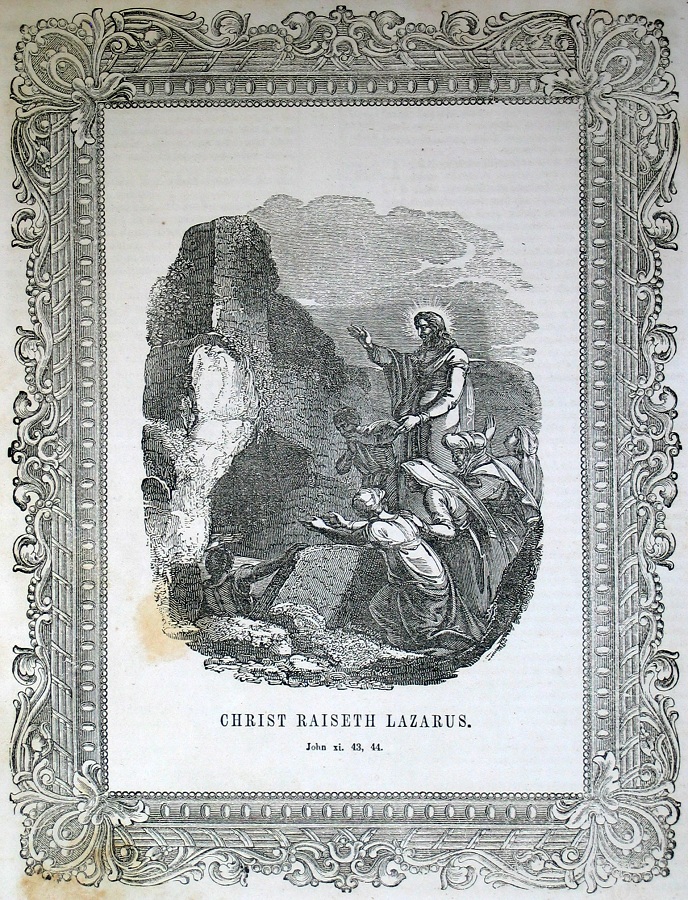 |
Lazarus is not the only person Jesus raised from the dead (see Lk. 7:11-15 and 8:49-55), but he is the most famous for two reasons. First, his resurrection was by far the most dramatic, and second, it was a crisis point in Jesus' deteriorating relationship with the religious leaders. Can you stand some more information about Greek? Most of John is about this difficult: "See Dick run. Run, Dick, run. See Spot run. Run, Spot, run." Once in a while you come to a sentence like this: "Dick is a gracile juvenile exemplar of the species Homo sapiens, while Spot is a robust tetrapod of the genus Canus." It is my impression that when I start looking up every other word in one of John's sentences, I have gotten to the climax of the story. In the story of Lazarus, that point is the first sentence in vs. 44. Of 16 words, 6 are rare or unique. John is not showing off. The event he is describing is extremely unusual, and the only words available to describe it are similarly unusual or unique. |
Fortunately for us, the resurrection of Lazarus is not really unique. It is merely the first resurrection of those who believe in Jesus Christ, and an illustration of what he means for all of us when he says, "I am the resurrection and the life.”
John 12:20-33
During the several centuries preceding Jesus' birth, the world had been prepared for his coming in a number of ways. One important phenomenon was that synagogues could be found all over the civilized western world, and many who attended these synagogues were not Jews, but Gentiles who believed in God but chose not to convert to Judaism. On the last day of Jesus' public ministry, one of his disciples is approached by some "Greeks," "who went up to worship at the feast." Now, "Greek" could and typically did mean "not Jewish," so we really don't know anything about them except that they were among these believing Gentiles. The passage does not say whether they got to see Jesus or not, although Wesley points out that this is a modest request, not to speak to him, but only to see him. I choose to believe that they were indeed part of the crowd on this day. And Jesus does address them, at least indirectly. "If anyone serves me," he says, "the Father will honor him. ... And when I am lifted up from the earth, I will draw all people to myself."
John 13
John's gospel differs in several ways from the Synoptic Gospels, Matthew, Mark, and Luke. For example, John's account of the Last Supper, from which today's reading is taken, is much more detailed. Mark and Matthew give nearly identical accounts of about 9 verses. Luke has about 24 verses. John devotes five chapters to this event. Why the big difference? For one thing, John's place at the table was directly next to Jesus, at a dinner for 13. He obviously had the best opportunity to hear and understand what Jesus said. For another, John's Gospel was written many years, even decades, after the other three. The Church had noticed that several aspects of Jesus' ministry were inadequately covered in the existing gospels, and John was asked to fill in some of the details. Most importantly, John spent these decades in the company of the Holy Spirit, thinking about what Jesus had said and done, and his gospel reflects this spiritual emphasis.
John 14:1-14
Jesus promises several times that whatever we ask in his name will be granted to us (vss. 13-14). So how come I don't get what I pray for? I think the tricky part of this is praying "in his name." Biblically speaking, "the name" is equivalent to the person. If I pray that something bad will happen to my enemy, that is not "in the name" of the person who loved his enemies (us, while we were still sinners) enough to die for them. If I pray that something good will happen to me at the expense of someone else, that is not "in the name" of someone who pointed out that God makes rain fall on the just and the unjust. If I pray for stuff, sometimes I'll get it and sometimes I won't, depending on whether God thinks it's good for me--the person in whose name I pray pointed out that God knows what I need. Occasionally something we pray for is in line with the will of God, but to grant our petition God would have to cross the will of another person, which he won't do.
On the other hand, if I pray for God to align my will with his, that certainly is "in the name" of the person who said, "Not my will, but thine, be done." If I pray for forgiveness, I will certainly get it. If I pray to be used for God's work, I'll get a job. So when our petitions are not granted, it's not a bad idea to reexamine them and make sure that we really are praying "in Jesus' name." Amen.
Copyright 2007, 2008, 2009, 2010, 2011, 2013 by Regina L. Hunter. All rights reserved. The illustration showing Christ and the Woman of Samaria is from the Binns family Bible, now in the private collection of Regina Hunter.
Opinions expressed on this page are solely those of the author, Regina Hunter, and may or may not be shared by the sponsors or the Bible-study participants. Thanks to the Holy Spirit for any useful ideas presented here, and thanks to all the readers for their support and enthusiasm. All errors are, of course, the sole responsibility of the author.
Our Sponsors:
St. John's United Methodist Church, "Transforming Lives Through Christ."
2626 Arizona NE, Albuquerque, New Mexico 87110
St. John's Music Ministries now has a YouTube channel, bringing you free concerts and choral music. Check it out!
Traditional worship services are held Sundays at 8:15 and 11:00 a.m. in the sanctuary. Casual worship services are held Sundays at 9:30 a.m. in the Family Life Center. Jazz Vespers are held monthly on the second Saturday at 5:00 p.m. in the sanctuary. St. John's feels especially called to the worship of God and to the service of our neighbors through our music program.
This website is supported in part by the generosity of Mrs. J. Jordan.